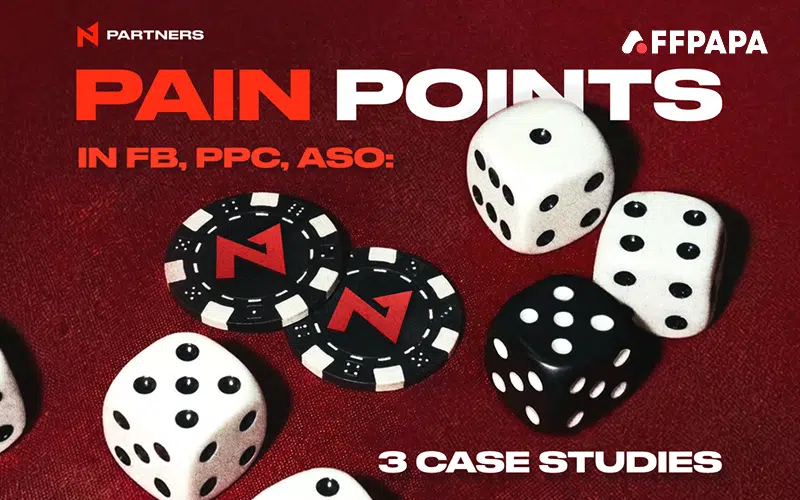
As part of the real case studies series, N1 Partners presents the second edition with practical knowledge and proven methods about ASO, FB, and PPC traffic with tested recommendations and analytics from experts.
Case study 1: FB traffic in Australia
In this case, the campaign targeted the Australian market for N1 Bet, with the goal of increasing conversions and reducing the number of duplicate users by combining creative assets with a PWA app.
The main problem was that the CTR was low, and most of the incoming players were already registered. This led to issues at the creative level, where user engagement begins.
Analytics showed that CTR was underperforming, and audience overlap was high, which means that the same users were exposed to the ads. The creative was a standard dynamic video featuring a popular slot game, with messaging focused on slot mechanics, but the broad targeting with high audience saturation led to declining engagement.
The hypothesis was that the creative had lost its effectiveness because it was no longer generating interest among new users. To address this, the team fully changed the creative with a more unique video covering a different slot, which was chosen by analyzing product data and audience activity.
After this, CTR increased immediately, and the number of duplicate users dropped, while the Reg2Dep rate stayed stable. The main takeaway from this case is that replicating top-performing creatives from spy tools without adaptation and analysis leads to worse results.
It’s important to focus on creative uniqueness but experiment with text, visuals, and triggers while keeping the main message.
Case study 2: PPC traffic in Canada
The second case focused on PPC traffic in Canada using Google OfferWall for the RollXO brands, with the objective of optimizing first-time deposit (FTD) costs and improving conversion efficiency.
The main challenge was high traffic acquisition costs, especially the cost per click (CPC), which was three times higher than that of other partners using the same traffic source. Additionally, there were irrelevant keywords that were driving traffic, with keywords connected to irrelevant slots and payment methods performing the worst.
The initial hypothesis was that the campaign relied too heavily on high-CPC keywords that had no relevance, while the ad copy “Best online casino – play and win right now!” turned out to be too generic and not specific enough.
The optimization process started with keyword refinement. Irrelevant and underperforming terms were removed, and a negative keyword list was introduced. However, the campaign structure stayed the same because keyword selection was the main driver of CPC.
After 35-40 hours, traffic acquisition costs decreased by €70–90, with the introduction of negative keywords proving to be the most impactful change. Being relatively new, the partner wanted to scale traffic as fast as possible without fully understanding keyword optimization mechanics, which was the biggest issue at the start.
This case is especially valuable for beginners, as it highlights core PPC principles and creates a chance to understand the fundamentals faster, avoid early mistakes, and not waste resources. More broadly, the takeaway is that speed doesn’t guarantee quality. Success depends more on analysis, testing, and thoughtful preparation.
Case study 3: ASO traffic in Germany
The last case studied ASO traffic in Germany for the Lucky Hunter brand, focusing on Android users, with the goal of increasing user retention after registration and boosting first and second deposits.
Low engagement after registration was the primary issue, as push notifications sent through the app weren’t effective, and users rarely returned to complete their first or second deposit. Users were dropping off after registration, suggesting a disconnect between expectations and actual experiences. This led to the main hypothesis being that users lacked motivation to deposit, possibly because of unclear or misleading communication about bonuses.
Testing focused on push notifications, with different headlines, descriptions, and messages, such as “Dein Bonus wartet auf dich, hol dir +50% auf deine Einzahlung und versuche erneut dein Glück! Verpasse deine Chance nicht – das Angebot ist zeitlich begrenzt.”
It was identified that users were receiving outdated bonus information, which affected their expectations and behavior. To solve the issue, reviews were slightly updated and refreshed, while push notifications were optimized.
Within just a week, the Reg2Dep conversion rate jumped from 14.77% to 31.17%, with the first improvements already noticeable after 1-2 days. Changes in push communication and updated bonus offers brought the biggest impact and became the main drivers of conversion growth.
The main takeaway: always keep bonuses and offer information up-to-date and synchronize all communication elements.
All three studies demonstrated that Facebook, PPC, and ASO traffic growth comes from continuous work with creatives, analytics, and communication, and performance drops can be used as a chance to optimize and turn them into real profit.