
The PropellerAds team shared a new iGaming case study showing how one partner managed to turn unstable tracking. The case study shows how shifting KPIs and funnel inconsistencies into a campaign that delivered 97,674 installs, 21,134 registrations, and 12,701 deposits within three months.
Karlina Berzina, Senior Account Strategist:
“This partner has been with us for a long time, and our collaboration goes well beyond just sourcing traffic. We have formats that let us guide users across the entire funnel: from broad reach and initial brand discovery to repeat touch points and optimization toward deposits and retention. For iGaming, this matters more than anywhere else: sustainable growth simply isn’t possible without retaining users and increasing their LTV.
That’s why our focus has shifted to being a true performance partner, not just a traffic source – one that helps advertisers work with audience quality across the full user lifecycle. To support this, we also have dedicated specialists who focus specifically on growing partners in the iGaming segment.”
Case overview
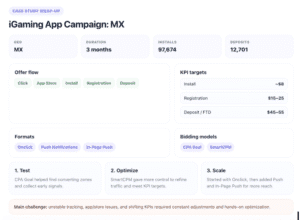
According to the case, one of the main challenges was the unstable campaign environment itself. This performance marketer dealt with inaccurate tracking, missing data, internal app and store-side issues, along with constantly changing KPIs throughout the campaign period. Because of this, the setup required continuous optimization and hands-on management at every stage of the funnel.
At launch, the campaign operated with the following KPI targets:
| KPI | Target |
| Install | ∼$8 |
| Registration | $15 – $25 |
| Deposit (FTD) | $45 – $55 |
The main goal was to maintain a stable funnel from install to deposit while keeping acquisition costs within acceptable limits.
Campaign setup
Karlina stated:
“Rather than making changes too quickly, we allowed campaigns to stabilize, then continuously refined the setup by removing non-performing or less relevant traffic and focusing on segments that contributed to installs, registrations, and deposits.”
To achieve this, the partner combined two bidding models instead of relying on a single approach. As highlighted in the case study, CPA Goal was used during the testing phase to quickly identify converting zones, while SmartCPM was later applied for manual optimization and scaling.
The traffic strategy also evolved gradually. The campaign initially launched with Onclick traffic, while CPA Goal and SmartCPM were tested in parallel. Once the setup showed stable performance, Push and In-Page Push formats were added to increase reach and improve overall volume.
Optimization flow
As highlighted in the PropellerAds case study, their partner followed a structured optimization flow to manage a funnel with multiple KPIs and unstable tracking conditions.
At the start, campaigns were given at least 2 days to stabilize without any optimization. During this period, the partner monitored performance across OS, devices, browsers, and traffic behavior to identify early trends and understand which segments contributed to installs, registrations, and deposits.
Karlina commented:
“Rather than making changes too quickly, we allowed campaigns to stabilize, then continuously refined the setup by removing non-performing or less relevant traffic and focusing on segments that contributed to installs, registrations, and deposits.”
Gradually eliminating non-converting zones
One of the main optimization rules was breaking traffic down into smaller segments (including zones, user behavior, and performance signals), to evaluate whether the traffic contributed to conversion goals.
Traffic segments that failed to drive results were excluded step by step to reduce inefficiencies and wasted spend.
Blacklist and whitelist rules
The partner also used a strict filtering system for blacklists and whitelists:
Rule 1: No Signal – zones spending more than the cost of two deposits without generating installs, registrations, or deposits were immediately blacklisted.
Rule 2: Empty Promise – zones generating large registration volumes without meaningful follow-up actions were also blacklisted.
Rule 3: Proven Performer – zones consistently delivering efficient conversions were added to the whitelist.
The case study also showed that blacklisting and whitelisting worked differently. Blacklisting was used as a fast reaction to poor traffic, while whitelisting required more time because traffic quality was measured by completed deposits, not just installs or registrations.
Respecting the conversion window
Another key part of the strategy was respecting the conversion window and analyzing user behavior patterns, including:
- how long users stayed engaged;
- how many days after install or registration they converted.
For this campaign, the testing window aligned with a 30-day conversion period.
The optimization process itself was divided into two stages:
Step 1: campaigns were left untouched for at least 2 days so the algorithm could stabilize and collect realistic cost data;
Step 2: after stabilization, the partner analyzed the data, applied the No Signal rule, and continued with further optimization.
Gradual format scaling
PropellerAds also noted that the partner scaled formats gradually instead of expanding aggressively from the start.
The campaign initially launched with Onclick traffic. After performance stabilized, Push and In-Page Push formats were added to broaden reach and increase volume.
Campaigns were also split by a bidding model to make testing and optimization more transparent.
The Main takeaways
As a result, over the course of three months, the campaign delivered:
97,674 installs | 21,134 registrations | 12,701 deposits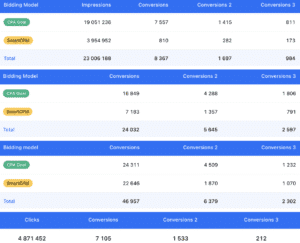
(Results after the first test of In-page push)
The partner also managed to reduce install costs, double deposit conversions, and successfully launch Push Notifications as an additional traffic source, currently showing positive early performance.
The main takeaway from the case is that stable iGaming scaling depends less on aggressive expansion and more on structured optimization, clear KPI management, and disciplined traffic filtering throughout the funnel.
Karlina shared:
“The success is in the simplicity. The offer follows a straightforward flow, supported by a mobile application available in official app stores. There’s no need to complicate the user journey. Traffic is directed straight to the app store download page, ensuring a seamless and frictionless experience for the user.”
The PropellerAds case shows that successful iGaming scaling comes down to structured optimization, clear KPI control, and gradual scaling across formats. By combining CPA Goal for testing with SmartCPM for optimization, the partner managed to turn an unstable setup into 97,674 installs and 12,701 deposits in just three months.
Use the strategy and launch your campaign now!