
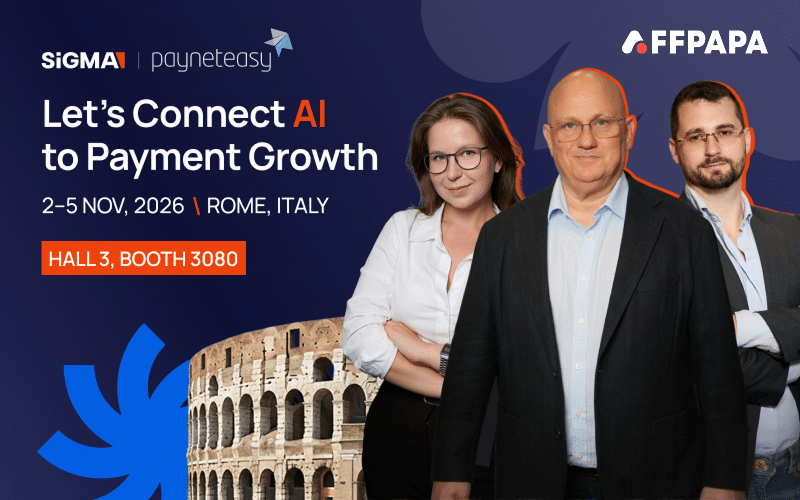
Payneteasy has introduced AI for Payments, two tools that let payment teams work with the Payneteasy platform through AI.
Payneteasy AI access via MCP: ask your payment data anything. MCP (Model Context Protocol) is an open standard that connects AI assistants to other systems. Payneteasy MCP connects the AI tools teams already use, such as Claude, ChatGPT and Copilot, to live payment data. With it, teams can:
- Ask questions in plain language and get answers straight from live gateway data.
- Find out quickly why payments fail by narrowing down declines by processor, country and card type.
- Check key numbers such as sales, refunds, chargebacks and fraud, without opening a dashboard.
- Analyse order processing logs: pull up the step-by-step processing log of any order, with its status and route, and let AI explain where and why it failed.
- Give your iGaming clients the same AI access to their own data, as a feature of the PSP’s gateway.
Currently, for security purposes, Payneteasy MCP is read-only. The AI can read data, but it can’t move money or change settings, and it never sees full card numbers or CVVs.
Payneteasy UI API: automate the routine. The UI API is the same interface that powers the Payneteasy back office, with more than 130 services and 1,500+ operations. Teams can use it to automate routine work, such as reconciliation reports and regular reporting, and connect their own AI agents where it makes sense. Access is controlled with restricted tokens, limited to specific tasks and revocable at any time.
Picture a Monday morning at an online casino
Card deposits are being declined more often than usual. On a normal day, this is the start of a long hunt: export the reports, compare the spreadsheets, ask the tech team, wait.
Now picture the same morning with Payneteasy AI for Payments.
The payments manager opens an AI assistant, such as Claude, and types a question:
“How did our approval rate move this week compared to last week?”
The answer comes straight from the gateway data. Next question:
“Break it down by processor, country and card type.”
One segment stands out. Then:
“What are the decline reasons there?”
And finally:
“Show me ten declined orders with their route and processing trail.”
Four questions later, the team knows where the problem is and who should fix it: the processor, the risk team or the developers. Nobody opened a dashboard.
This is AI for payments
Payneteasy connects AI assistants directly to its payment platform. Teams can use the AI tools they already know: Claude, ChatGPT, GitHub Copilot, Cursor, Google Gemini and others.
Teams simply ask in plain language. For example:
“What were our sales yesterday compared to last week and last month?”
“What’s the chargeback ratio for this merchant by card type?”
“Find the declined order for invoice INV-20455 last week and tell me why it failed.”
“Which gate is this endpoint routed through?”
Finance, support and engineering get their answers without logging in to a dashboard.
It looks. It never touches.
Letting AI near payments sounds risky. That’s why Payneteasy AI for Payments was built to be read-only from day one.
- No money moves. The AI can read and report. It can’t approve, capture or refund payments, move money or change settings.
- No card data. According to our PCI DSS Level 1 compliance, full card numbers and CVVs can’t be accessed via the AI agent.
- Access under control. Each connection uses its own access token. It is limited in scope and time, and can be switched off at any time.
Why iGaming should care
PSPs using Payneteasy platform can give their casino and iGaming clients the same plain-language access to their own data, as a feature of the gateway. A white-label gateway with AI access included can go live under the partner’s brand in 2–4 weeks.
Boaz Gam, CEO of Payneteasy, said:
“At Payneteasy, we give our partners AI access they can actually trust with their payments. You ask your AI agent what your sales were yesterday compared to last week and last month, and get a straight answer from gateway data. And when you’re ready for AI to do more, you decide exactly what it’s allowed to do.”
Next step Payneteasy UI API: AI that does the work
Answers are just the start. For teams that want AI to take over routine back-office tasks, Payneteasy also offers Payneteasy UI API. It is the same interface that powers the Payneteasy back office, with more than 130 services and 1,500+ operations. Through it, AI agents can help automate work such as merchant onboarding, reconciliation reports and batch adjustments.
Here too, access stays under control. Each agent gets its own restricted token, limited to the exact tasks it needs, valid for up to 180 days and revocable at any time.
Available now
Payneteasy AI for Payments is live. Want to see it in action? Visit the Payneteasy team at SiGMA World Summit in Rome, 3-5 November 2026, at Hall 3, Booth 3080. The team will run a live demo, answer questions and show how it fits into the payment setup. Book a live demo in Rome. Can’t make it to Rome? Learn more and book a demo any time at payneteasy.com.