
A casino affiliate deal can look excellent on a spreadsheet.
CPA is competitive. RevShare sits above market average. Conversion data looks promising, creatives are ready, target markets are open, and the affiliate manager responds quickly.
All of that matters.
But it answers only one part of a bigger question:
What kind of business are you actually sending players to?
Affiliate teams naturally focus on acquisition. They compare commission models, conversion rates, retention, player value and available GEOs.
Long-term partnerships require another layer.
Once a player deposits real money, performance depends on factors that sit outside the acquisition funnel: legal ownership, licensing, withdrawal procedures, verification rules, market restrictions, complaint handling and operational transparency.
That is where casino affiliate due diligence becomes useful.
In practical terms, due diligence means checking whether commercial opportunity and operational credibility support each other before meaningful traffic is sent.
A strong deal should survive eight basic questions:
- Who legally operates the casino?
- Which company holds the relevant gambling licence?
- Does that authorisation cover the promoted domain?
- Is any white-label or group structure understandable?
- Are withdrawal and KYC rules reasonably clear?
- Do complaints reveal recurring operational patterns?
- Do approved markets match the affiliate’s traffic?
- Does the deal still make sense once those risks are understood?
For affiliates building a long-term media brand, those questions matter just as much as headline commission.
High Commission Does Not Automatically Mean a Strong Partnership
Commission structures are easy to compare.
Operator quality is harder.
Consider two hypothetical programmes.
| Factor | Operator A | Operator B |
| RevShare | 50% | 40% |
| CPA | Higher | Lower |
| Legal operator | Difficult to identify | Clearly disclosed |
| Licence coverage | Requires clarification | Easy to verify |
| Withdrawal information | General | Clear limits and process |
| KYC information | Buried in terms | Visible before cashout |
| Restricted markets | Ambiguous | Clearly defined |
| Complaint handling | Inconsistent | Clear escalation route |
Operator A may still prove to be a good partner. Missing information does not automatically indicate poor conduct.
It does mean more questions should be answered before traffic scales.
This is where risk-adjusted affiliate economics becomes useful.
Headline economics measure commercial upside:
- CPA
- RevShare
- conversion
- retention
- player value
A more mature assessment adds operational context:
- ownership transparency
- licensing clarity
- withdrawal predictability
- KYC transparency
- complaint patterns
- market restrictions
- compliance exposure
A high-paying programme does not become unattractive simply because one risk factor exists.
The important point is that commercial terms make more sense once the business behind them is understood.
That distinction becomes especially important for affiliates trying to build authority over several years rather than monetise a disposable traffic source.
First Identify Who Actually Operates the Casino
Casino branding can hide a surprisingly complex structure.
A player may see one public brand while several businesses sit behind it:
Casino brand → legal operator → licence holder → platform or white-label provider → payment infrastructure
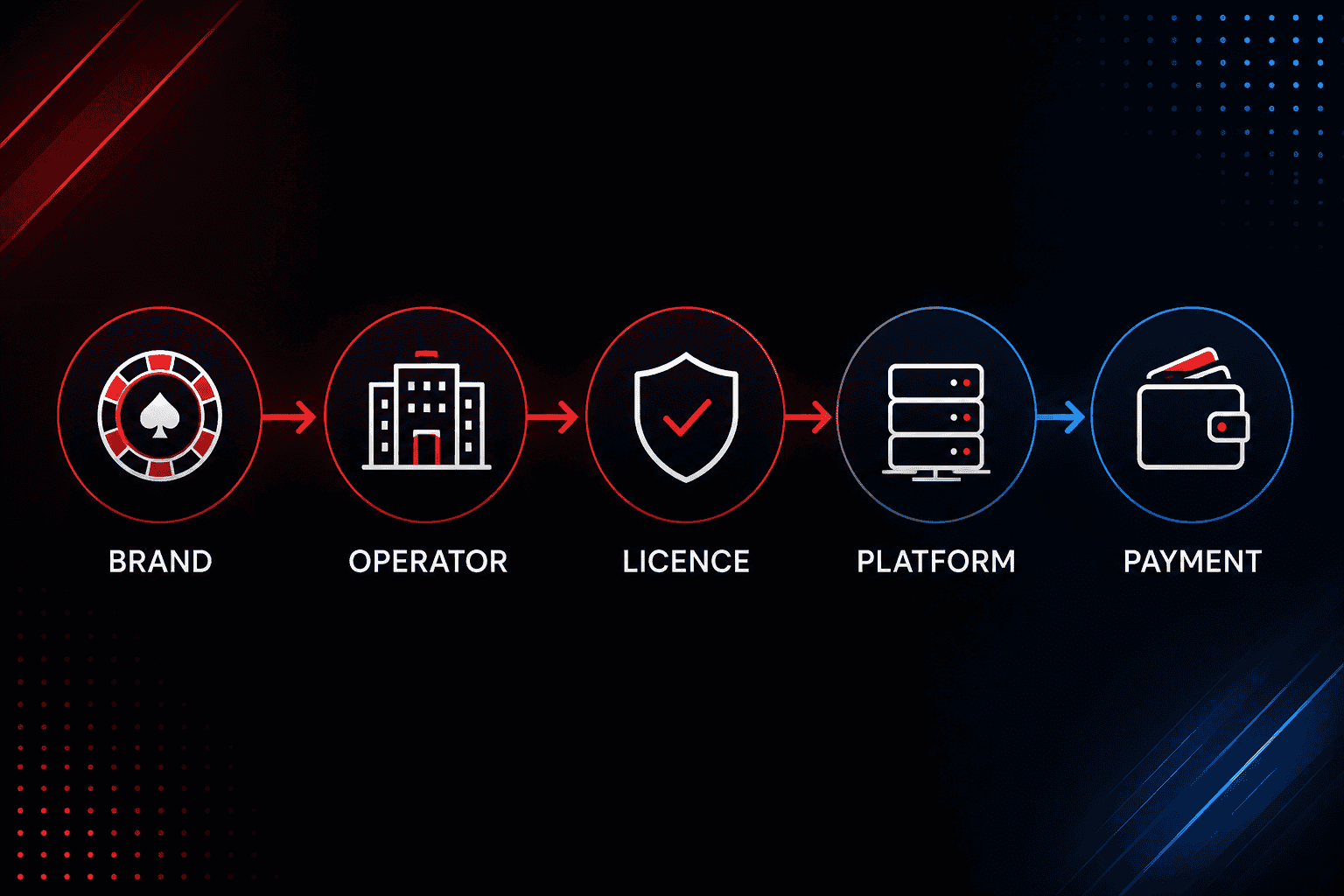
Sometimes one company controls most of those layers.
In other cases, several entities are involved.
Neither structure is inherently problematic. What matters is whether responsibility can be followed from one layer to another.
Start with legal documents.
Terms and Conditions, Privacy Policy, licensing disclosures, responsible gambling pages and footer information should provide a reasonably consistent picture of who operates player accounts.
CasinoIndex follows the same logic when explaining how to verify the operator behind an online casino. The useful check is not simply the name displayed on the homepage, but the relationship between public brand, legal operator, licence holder, authorised domain and potential complaint route.
That distinction becomes critical during disputes.
Players do not enter a legal relationship with a logo.
They deal with a company.
White Labels Make Ownership Checks More Important
White-label arrangements are common across iGaming.
A casino brand may focus heavily on acquisition and marketing while technology, account infrastructure, games, compliance tools or payment systems come from another provider.
Affiliates do not need to map every technical vendor.
They should, however, understand who carries responsibility for the player relationship.
That becomes relevant when someone faces:
- a disputed withdrawal;
- additional verification;
- an account restriction;
- a bonus-related dispute;
- a payment ownership issue;
- a formal complaint.
Group structures matter as well.
Several casino brands may share the same operator, platform or internal risk policies. When that happens, apparently separate brands can produce similar account rules, payment procedures or complaint patterns.
This does not make sister brands unsafe.
It simply means brand-level analysis can miss important operator-level relationships.
Licence Checks Should Connect Company, Status and Domain
A licence badge alone proves very little.
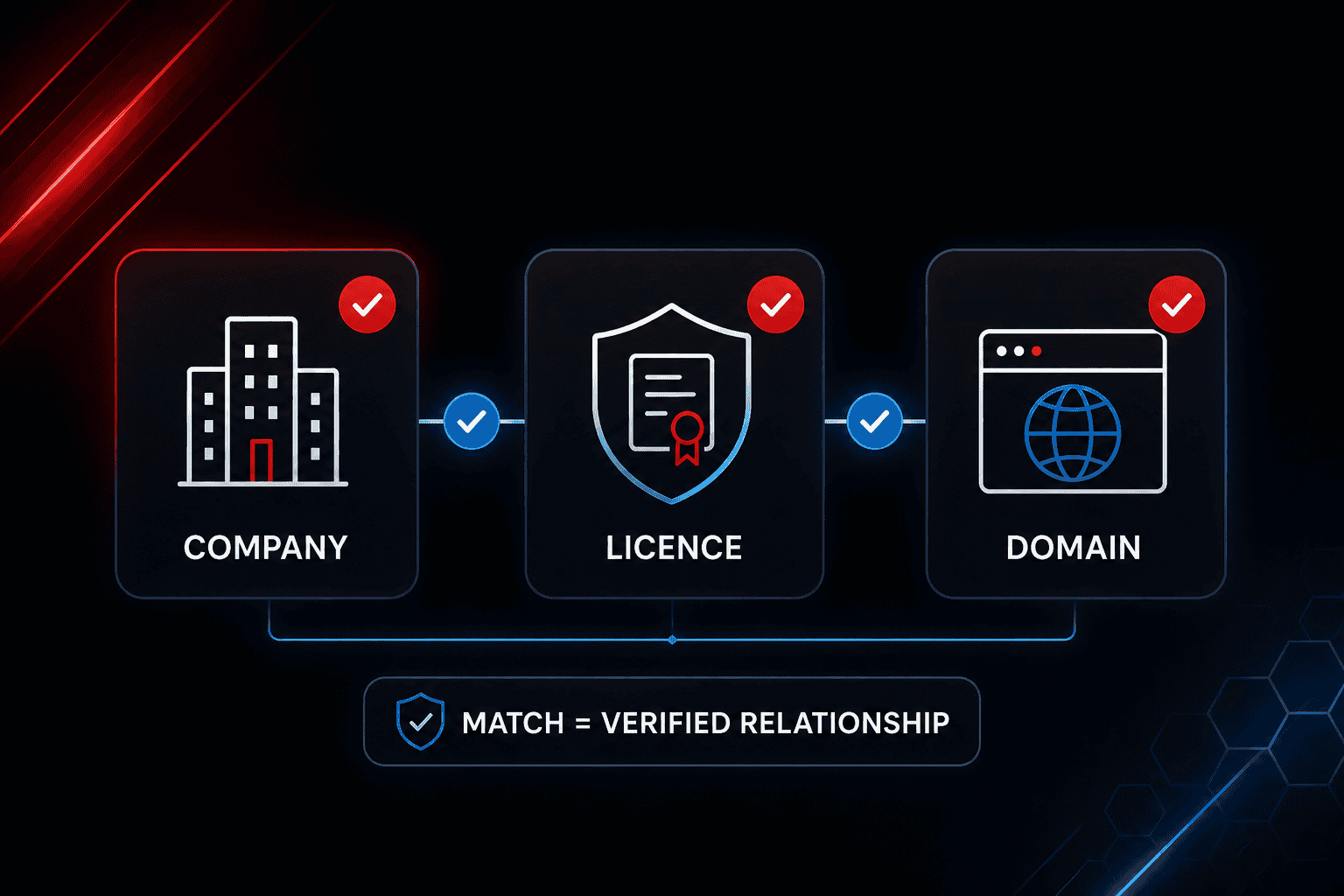
A stronger check connects three elements:
legal entity → regulatory authorisation → player-facing domain
This matters because regulatory records increasingly allow businesses and users to verify those relationships directly.
Public registers maintained by authorities such as the UK Gambling Commission and Malta Gaming Authority can help confirm operator information and licensing status.
Curaçao now makes the operator-to-domain relationship particularly explicit.
Under the Curaçao Gaming Authority’s current certification framework, a B2C Certificate of Operation Seal is linked to an approved and registered player-facing domain. When the seal is used correctly, clicking it should lead to the CGA’s official certificate platform, where the relevant domain, licensed operator and current licence status can be checked.
That is different from a general License Certificate.
A License Certificate confirms that an entity holds a valid licence, but it is not itself proof that every domain associated with that business is authorised for player-facing operations.
For affiliates, this makes domain-level verification a practical part of due diligence rather than a cosmetic licence check.
A useful verification chain looks like this:
| Check | Question |
| Operator | Which company controls player accounts? |
| Licence | Which entity holds the authorisation? |
| Domain | Does it cover the promoted website? |
| Status | Is it currently valid? |
| Scope | What activity or market does it cover? |
| Escalation | What happens if a serious dispute develops? |
The regulator’s name also does not tell the whole story.
Different licensing systems provide different levels of oversight, enforcement, transparency and player recourse. That is why what makes a casino licence meaningful in practice depends on more than the badge shown in a footer. Operator identity, domain coverage, current status and realistic enforcement options all matter.
Any mismatch deserves clarification before significant traffic is sent.
Withdrawals and KYC Reveal Operational Quality
Casino acquisition happens at the easiest part of the customer journey.
Registration is designed to be smooth.
Deposits are designed to be fast.
Promotions are designed to convert.
Operational quality becomes clearer when money needs to move in the opposite direction.
Withdrawals can involve account reviews, identity verification, payment ownership checks, AML controls, source-of-funds requests or bonus compliance reviews.
None of those processes is automatically a warning sign.
Responsible operators need fraud controls and may have regulatory obligations to verify customers.
A better measure is predictability.
Can players understand likely requirements before depositing?
Are processing times explained?
Can withdrawal limits be found easily?
Does the operator explain when additional checks may apply?
The goal should not be zero friction.
It should be predictable friction.
A clearly disclosed security review is very different from an unexpected restriction that appears only after a customer wins.
Crypto Makes This Distinction Especially Important
Crypto gambling provides a useful example.
A fast blockchain does not guarantee fast casino approval.
Network settlement and operator approval are separate processes.
A withdrawal can be technically capable of settling within minutes while still requiring internal review before the transaction is broadcast.
That means affiliates should be careful with claims such as “instant withdrawal”.
What does “instant” actually describe?
Immediate request submission?
Automated approval?
Fast blockchain confirmation after release?
Only verified accounts?
Only certain amounts or currencies?
Those are very different promises.
Accurate marketing should reflect the process players actually experience rather than the fastest technical component inside it.
Test More Than the Deposit Funnel
A successful deposit test confirms that the cashier works.
It does not show how a platform behaves under pressure.
Before promoting a new brand at scale, affiliates should examine the cashout side of the product.
Can players find withdrawal limits without searching several documents?
Are payment-method restrictions understandable?
Does the operator explain when KYC may occur?
Are VPN restrictions, duplicate-account rules and restricted countries clearly documented?
If crypto is supported, are networks identified properly?
Can a user understand what happens if a payment account or wallet does not match expected ownership information?
These details matter because affiliate managers often work primarily on acquisition.
They may not know every operational rule used by payments, compliance or risk teams.
That is not unusual.
When an important question cannot be answered immediately, the right response is not to assume the best-case interpretation.
Ask for clarification.
Complaint Volume Matters Less Than Complaint Structure
Every large gambling operator attracts complaints.
Raw review scores therefore have limited value on their own.
A negative comment can come from genuine misconduct, misunderstanding, failed verification, bonus violations, duplicate accounts or simple frustration after losing money.
Useful due diligence looks for repeated structures rather than isolated anger.
Imagine several unrelated players, across different dates and platforms, describing withdrawals stopping at the same stage.
Or multiple complaints mention similar document requests only after larger wins.
Perhaps several sister brands produce disputes around the same clause.
Those patterns deserve more attention than one extreme review.
A disciplined complaint analysis separates three categories.
Verified information
Facts found in official terms, regulatory records or operator documentation.
Player reports
Individual claims that may not be independently proven.
Editorial judgement
Interpretation based on multiple signals rather than one allegation.
That separation protects both sides.
Ignoring complaints entirely is weak research.
Treating every complaint as proof is equally unreliable.
Patterns provide the useful middle ground.
Compliance Fit Should Be Clear Before Campaign Launch
Due diligence works both ways.
Affiliates want reliable operators.
Operators need affiliates whose traffic sources and marketing methods fit their regulatory obligations.
Rules differ across jurisdictions, so one market’s requirements should never be treated as universal.
Still, several practical questions apply across most serious partnerships.
Before launch, both sides should understand:
- approved markets;
- restricted GEOs;
- permitted traffic sources;
- bonus messaging rules;
- responsible gambling requirements;
- age-targeting restrictions;
- permitted brand claims;
- paid-search rules;
- social or influencer restrictions.
A casino being technically accessible from a country does not necessarily mean the operator wants or is permitted to acquire customers there.
Technical availability is not the same as approved acquisition.
Clear programme rules reduce that ambiguity.
They also make campaigns easier to scale because compliance questions are answered before traffic is already flowing.
Product Due Diligence Prevents Misleading Claims
Affiliates promote more than an operator.
They also promote games, payments, features and bonuses.
Those products can vary by market.
One casino may provide different slot libraries, live dealer tables, payment methods or promotional mechanics depending on the player’s location.
Provider agreements, local regulation and platform configuration can all influence availability.
Games may also exist in more than one approved RTP configuration.
That makes absolute claims risky.
“Casino X offers Game Y” may be correct for one country but wrong for another.
The same problem appears with payment methods.
A casino might support a wallet or cryptocurrency globally while limiting deposits or withdrawals through that method in particular jurisdictions.
Product verification should therefore match the audience being targeted.
Good affiliate content describes what the relevant customer is likely to receive, not the largest global catalogue available somewhere inside the operator’s ecosystem.
Turning Due Diligence Into a Partnership Decision
Once operational checks are complete, commercial metrics can return to the centre of the decision.
CPA, RevShare, conversion and retention still matter.
They simply become more useful once the affiliate understands who operates the brand, how licensing applies, what players may face during verification or withdrawal, and whether recurring complaints reveal a meaningful pattern.
A practical decision can be built around four dimensions:
Commercial value — CPA, RevShare, conversion and retention.
Operational quality — account rules, withdrawals and verification transparency.
Regulatory clarity — operator identity, licence status and domain coverage.
Reputational exposure — complaint patterns, communication quality and market fit.
No single factor decides whether a partnership works.
A lower-paying operator is not automatically better because its legal pages are clearer.
A higher-paying programme is not automatically worse because its corporate structure is complex.
Due diligence has a simpler purpose:
Replace avoidable uncertainty with information before traffic scales.
Strong Affiliate Partnerships Leave Fewer Important Questions Open
CPA and RevShare will remain central to iGaming affiliate marketing.
They should.
But an affiliate is not promoting a commission percentage.
It is introducing an audience to an operator.
That operator controls many of the factors shaping what happens after conversion: account rules, withdrawals, verification, market restrictions and complaint handling.
Long-term affiliate value therefore depends on more than how efficiently a registration turns into a first-time depositor.
Strong partnerships tend to leave fewer important questions unanswered.
Ownership can be understood.
Licensing can be checked.
Market restrictions are clear.
Operational rules are predictable enough to explain.
Questions receive useful answers before they become disputes.
Commercial terms still need to work.
But once an affiliate has rankings, returning users, direct traffic and a reputation to protect, the highest commission is no longer automatically the best deal.
A better question is:
Does this partnership still make sense once we understand the business behind the offer?