Over a 26-month period, the brand scaled its monthly budget from an initial $30,000 in testing up to hundreds of thousands of dollars, with the goal of building long-term retention rather than chasing quick signups. The campaign produced more than 24,000 registrations and 9,400 real first deposits (RFDs), but as it grew, the team began noticing a drop in traffic quality even though costs held steady, a change that prompted them to pause scaling and take a closer look at what was happening.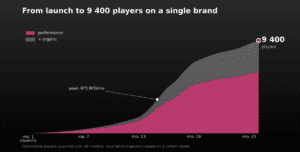
This case study breaks down those warning signs, why the team stepped back, and what lessons can be carried into future campaigns.
Finding the right influencer model
In the early stages, Makeberry Influence tested different influencers at low volume, paying attention not just to first-time deposit (FTD) counts but to which partners actually brought back players after their first deposit, and which audiences formed the profitable part of each cohort. Some partners performed poorly by this measure, with as much as 75% of their referred players making only a single deposit before disappearing.
As the selection process got more refined and focus on the Hungarian market increased, that single-depositing rate fell to between 24% and 45%, depending on the month, by mid-2025, while FTD volume increased to around 300 per month. That improvement gave the team confidence to begin scaling.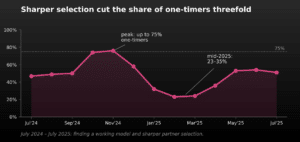
Scaling the GEO
Between August 2025 and January 2026, Hungary generated 500 to 675 RFDs per month through direct performance channels, marking the brand’s strongest stretch for both volume and traffic quality in this market. The cost per player stayed fairly stable throughout, around $190-220 through direct referral performance, meaning tripling output didn’t come with a proportional rise in acquisition costs.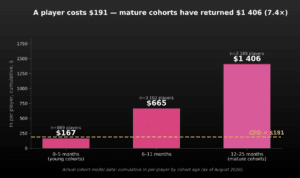
That cost was on the higher side for a Tier 2 market, with competitors typically paying $120-150 per player at the time. Makeberry Influence’s approach was more expensive: investing heavily to reach the country’s most engaged gambling audience through top streamers, paired with stronger in-brand offers. Cohort data broken down by age showed how this investment translated into player quality, and volume and cost-per-deposit tracking confirmed the team’s working theory that influencer traffic performs best at scale, with the most cost-efficient results coming from larger campaigns run through top-tier streamers.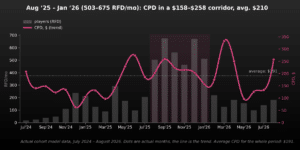
Makeberry Influence says it was among the first in the market to fully measure and understand this dynamic.
Signs of declining traffic quality
After peaking at 500-675 monthly RFDs, both cost-per-deposit and RFD volume started trending downward. At the same time, the one-timer rate climbed above 70% and stayed there even as CPD dropped as low as $96, a disconnect that raised questions about what was really going on.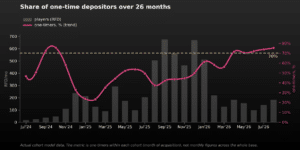
Cohort-level tracking showed this change taking place as the campaign moved through its scaling phase and beyond. By January 2026, the team had worked through the entire pool of major influencers in the country, a relatively small market where covering the main streamer pool required just over $1 million in total spend.
With much of the audience already familiar with the brand, performance campaigns were increasingly re-engaging existing users rather than winning new ones. Traffic got cheaper, but incoming cohorts got noticeably weaker, marking the start of a new phase in the campaign.
Measuring brand awareness
The rising one-timer rate signaled a real issue with new traffic, but it didn’t necessarily mean the market had hit its ceiling. Brand awareness, typically tracked through views, reach, and clicks, is hard to tie directly to outcomes, and wasn’t factored into the team’s numbers up to that point.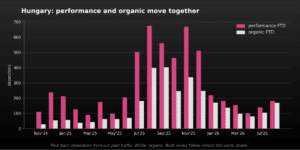
To understand its actual impact, Makeberry Influence compared two traffic sources: referral-link traffic from influencers (direct performance) against Direct and SEO traffic over the same period. The data showed a clear correlation between the two during periods of heavy scaling and pullback. Since no other acquisition channels were active in Hungary for this brand, the team could isolate influencer impact cleanly; some users clearly weren’t clicking referral links at all, instead finding the brand later through search or by typing in the URL directly. That reinforced the idea that influencer marketing works best alongside SEO and PR rather than in isolation.
How organic traffic pushed the GEO into profit
Many users who discovered the brand through influencers didn’t convert via referral link, returning instead through organic search or direct visits, a common pattern that often goes unaccounted for in campaign reporting. Tracking the split between brand-driven and performance-driven traffic over time revealed just how strong this effect was: the organic traffic share grew from 25% to nearly 70% once heavy spending stopped.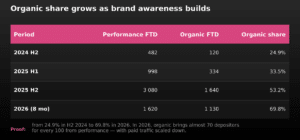
From March to June 2026, the team paused new acquisition spend to see how the existing base would hold up on its own, factoring in audience fatigue from the earlier push. The result: organic channels brought in an extra 52.2% in users and $472,000 in NGR with no added spend, helping the Hungary market reach profitability faster than originally projected and effectively recovering the investment.
For context, the team had set an 8-month payback target for each cohort, including the newest ones, a reasonable window for influencer traffic, compared to the 2-4 month targets many teams aim for with channels like Facebook. In this case, the combined effect of brand awareness and organic traffic meant the GEO reached its targets faster than direct performance data alone would suggest.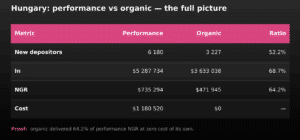
Hungary has since been set as one of the brand’s priority markets. Additional acquisition channels are now being layered in, the brand has been localized into Hungarian, and the overall scaling approach has been validated going forward.
Applying the lessons to future markets
Beyond the results themselves, the Hungary campaign gave Makeberry Influence a repeatable framework for launching new markets: how to identify the right partners, test funnel performance, assess traffic quality, and recognize when a pool of quality influencer traffic is running dry. The team says it has already begun applying these lessons to bigger Tier 1 markets and additional channels, with more detail to come in future case studies.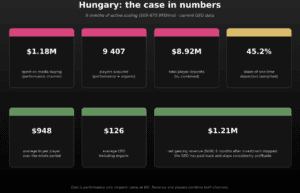
For readers looking to apply similar principles, Makeberry Influence has put together a full guide that’s available by filling out a Google Form, covering how to vet influencers before launch, choose the right market and platform, evaluate audience quality, spot fraudulent traffic, and assess campaign economics, drawing on real benchmarks from its work in both Tier 1 and Tier 2 markets.